
Local SEO for roofers in London means getting your business to show in Google’s map results and local listings when homeowners search for roof repairs. The core steps are a verified Google Business Profile, genuine reviews, consistent business details, and service pages that name the London areas you actually cover.
A roofing enquiry rarely starts calmly. It starts with a ceiling stain on a Sunday, a slipped slate after a storm, or a flat roof that holds water after every shower. When I look at a roofer’s online presence, I ask one question first: what does that homeowner see when they search from their phone? If the answer is a competitor with a full map listing, plenty of reviews and a clear service page, the job is already half gone.
This guide is how I would fix that for a London roofing firm, step by step, using Google’s own rules and UK law as the guardrails. If you would rather have help applying it, my local SEO services for London businesses cover this work.
What is local SEO for roofers, and why does it matter in London?
Local SEO is the work of making your business easy to find and easy to trust when someone searches near them. For a roofer, four things have to work together: your Google Business Profile, your reviews, the service and area pages on your website, and the way your business details appear across the web.
London makes this harder because there are many roofers and homeowners search in several ways. Competitor guides list searches such as “roofers London”, “roofing company London”, “flat roofing London” and “London roofing contractors”. Urgent searches like “roof repair London” and “emergency roofer near me” come from people who need someone now, so I treat them as worth more than general research searches.
Trust is the other half. A Which? survey reported by the NFRC found that only about half of householders thought roofers were trustworthy, and 46% worried about being ripped off. The survey is not new, but I still use that worry as my starting point. My view is that your online presence is the first inspection a customer carries out, so it has to answer that worry before the phone rings.
How does Google decide which London roofers appear in the map results?
Google says local results are based mainly on relevance, distance and prominence, and it states plainly that you cannot pay for a better local ranking.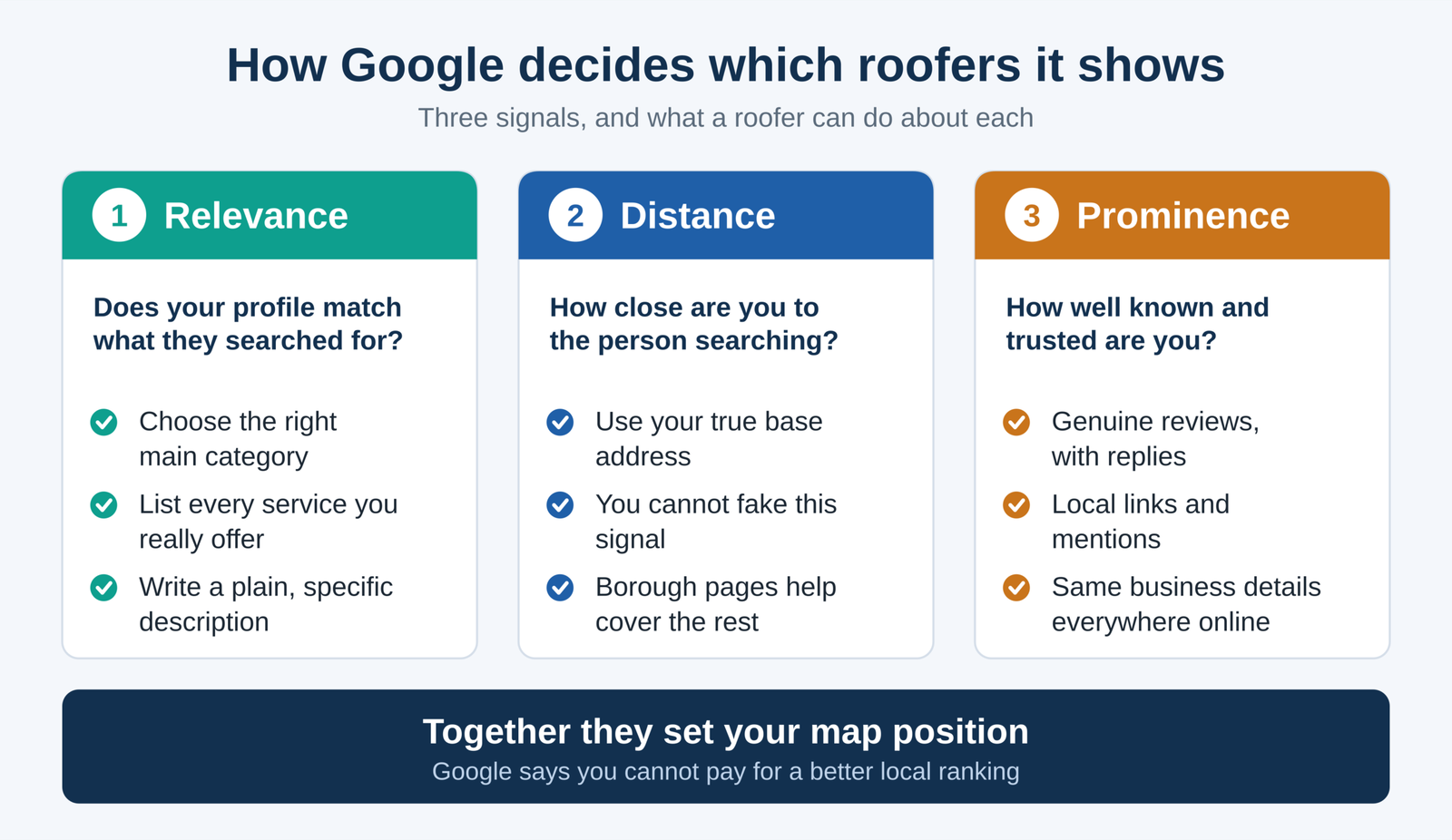
This is how I use each signal when I look at a roofing business:
- Relevance. I check that the profile and the website say exactly what the roofer does. A firm that repairs flat roofs and does leadwork should say so, rather than hiding behind “roofing services”.
- Distance. Nobody can honestly change where your business is. What I can do is make sure the address Google holds is accurate and that your website shows the areas you really cover.
- Prominence. Google counts review volume and score, and draws on information from across the web, such as links, articles and directories. I look at who mentions you, not only how often.
That is why a tidy profile alone rarely holds a ranking. The website and the wider web have to back it up.
Should a London roofer show a business address on Google?
Most roofers travel to the customer, which makes them service-area businesses. That changes what Google expects from you.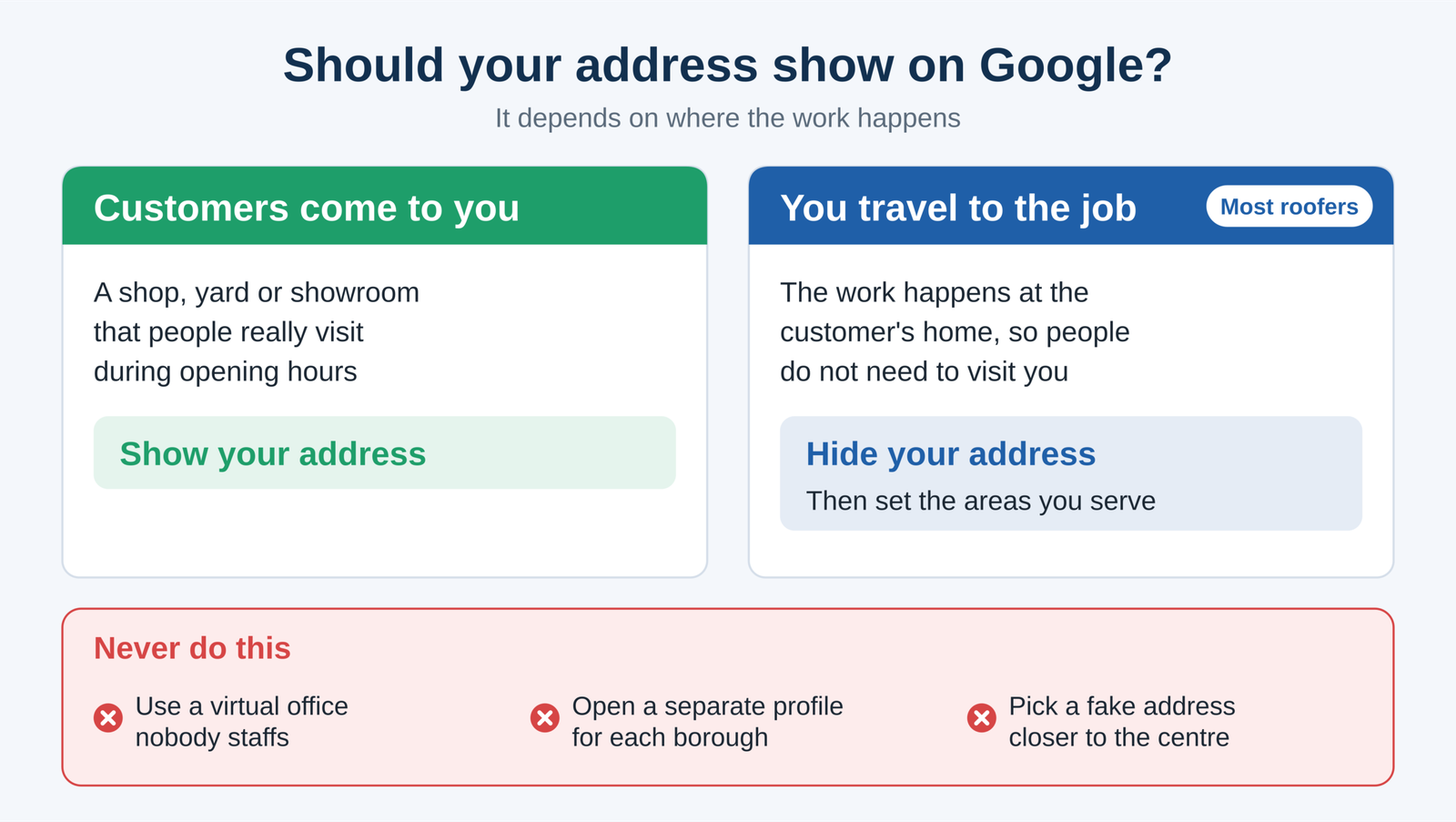
Google’s guidelines say a service-area business should have one profile for its central location with a designated service area, and that a rented virtual office is not eligible unless it is staffed during business hours. If you travel to customers, Google advises hiding your address.
If I see a roofer using a rented desk at a central address just to look closer to the middle of London, I tell them to remove it. It goes against Google’s rules and it puts the whole profile at risk. My practical rules are these:
- Use the address you actually work from, even if it is a home address that you then hide.
- Keep one profile per business. Do not create extra profiles for each borough.
- One virtual office provider summarises Google’s rule as a service area within roughly two hours of driving from your base. Check the current wording in Google’s help pages before you rely on it.
- One guide notes that proximity is measured from the hidden address, not from the areas you list. A roofer based in Croydon should not expect to beat a Haringey roofer for a search made in Haringey. Your borough pages have to do more of the work.
What do I put in a roofer’s Google Business Profile?
Google tells businesses to keep their profile accurate, complete and current. This is the checklist I use for a roofing profile:
- Primary category: the one that best matches your main work, with secondary categories only for services you genuinely provide.
- Services: flat roof repair, pitched roof repair, leadwork, chimney repairs, gutter work, whatever you really do, each with a plain description.
- Service areas: the London areas you actually cover, not every postcode you would like to win.
- Hours: claim emergency or 24-hour availability only if someone answers.
- Phone and website: exactly the same details as your site footer.
- Photos: your own completed jobs, including before and after shots of the roof itself.
- Reviews: a steady flow, and a reply to every one, good or bad.
When I audit a profile, the first three things I check are whether the main category matches the work that earns the most, whether every service is listed in plain words instead of a string of keywords, and whether the emergency claim is backed by a phone that gets answered. If you want a hand with any of it, Google Business Profile and map pack optimisation is part of the same service.
How do I get reviews without breaking UK law?
Since 6 April 2025, the Digital Markets, Competition and Consumers Act 2024 has prohibited fake reviews and concealed incentivised reviews. Penalties can reach 10% of annual global turnover.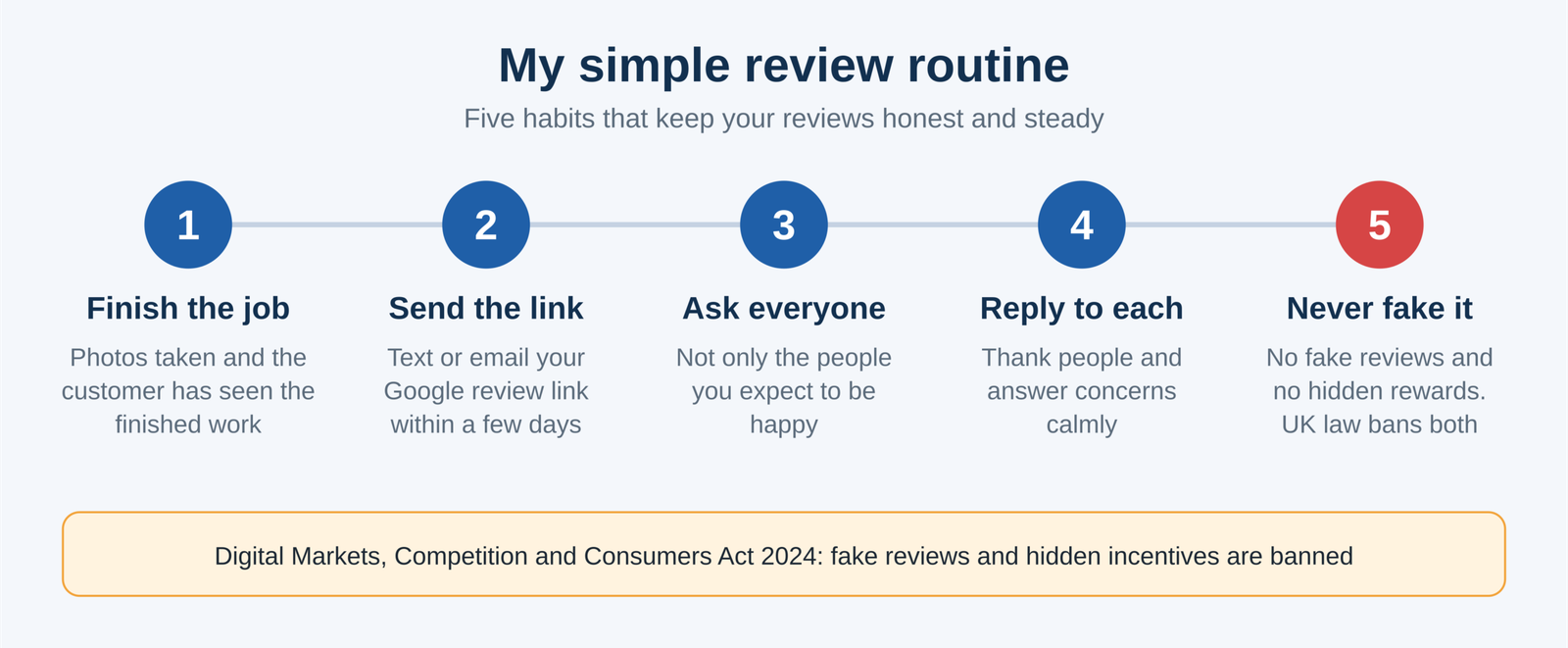
- Do not pretend to be a customer and write reviews about your own business, and do not commission anyone else to write them.
- Incentivised reviews are only acceptable when they are genuine and clearly disclosed. For a small roofing firm, my advice is simple: do not offer discounts or prizes for reviews at all.
- The CMA reviewed more than 100 business websites and found over half could be failing its guidance, including some with no policy on incentivised reviews. If you show reviews on your site, add a short, clear review policy.
My routine is plain. After a job is finished and the customer has seen the result, send your review link by text or email. Ask everyone, not only the people you expect to be happy, because that keeps the rating honest. Then reply to every review within a few days, and answer criticism calmly and factually.
Which trust signals should a roofing website show?
My rule is to show only what you hold, and to link each badge to your entry on the official register so a customer can check it.
| Signal | What it is | Notes |
|---|---|---|
| NFRC membership | Trade association for roofing contractors | Membership is voluntary, and NFRC is a scheme provider to TrustMark |
| TrustMark | Government-endorsed quality scheme for home improvement | Not every NFRC member joins TrustMark, and some TrustMark firms are general builders rather than roofing specialists |
| CompetentRoofer (NFRC CPS) | Lets registered roofers self-certify work for Building Regulations | Refurbishing 50% or more of a roof’s area requires either a Competent Person Scheme contractor or contact with Local Authority Building Control before work starts |
| Companies House entry | Shows a limited company exists and is active | Display your company number if you trade as a limited company |
| Insurance and guarantees | Public liability cover, plus workmanship guarantees | NFRC recommends an Insurance Backed Guarantee that sits alongside the contractor’s own guarantee |
The details come from the NFRC homeowner guidance and its TrustMark roofing contractors page. One more point worth stating on your site: according to Whito’s guide, there is no licence required to trade as a roofer in the UK. That is a vendor source, so verify it on GOV.UK. If it holds, it explains why verifiable credentials carry so much weight.
How should I structure service and borough pages?
Google’s local ranking draws on your website as well as your profile. MagnifyLab advises that a roofer covering all of London should have separate pages for the main areas. The risk is thin, copy-paste pages with only the borough name swapped, so I build every page around something real.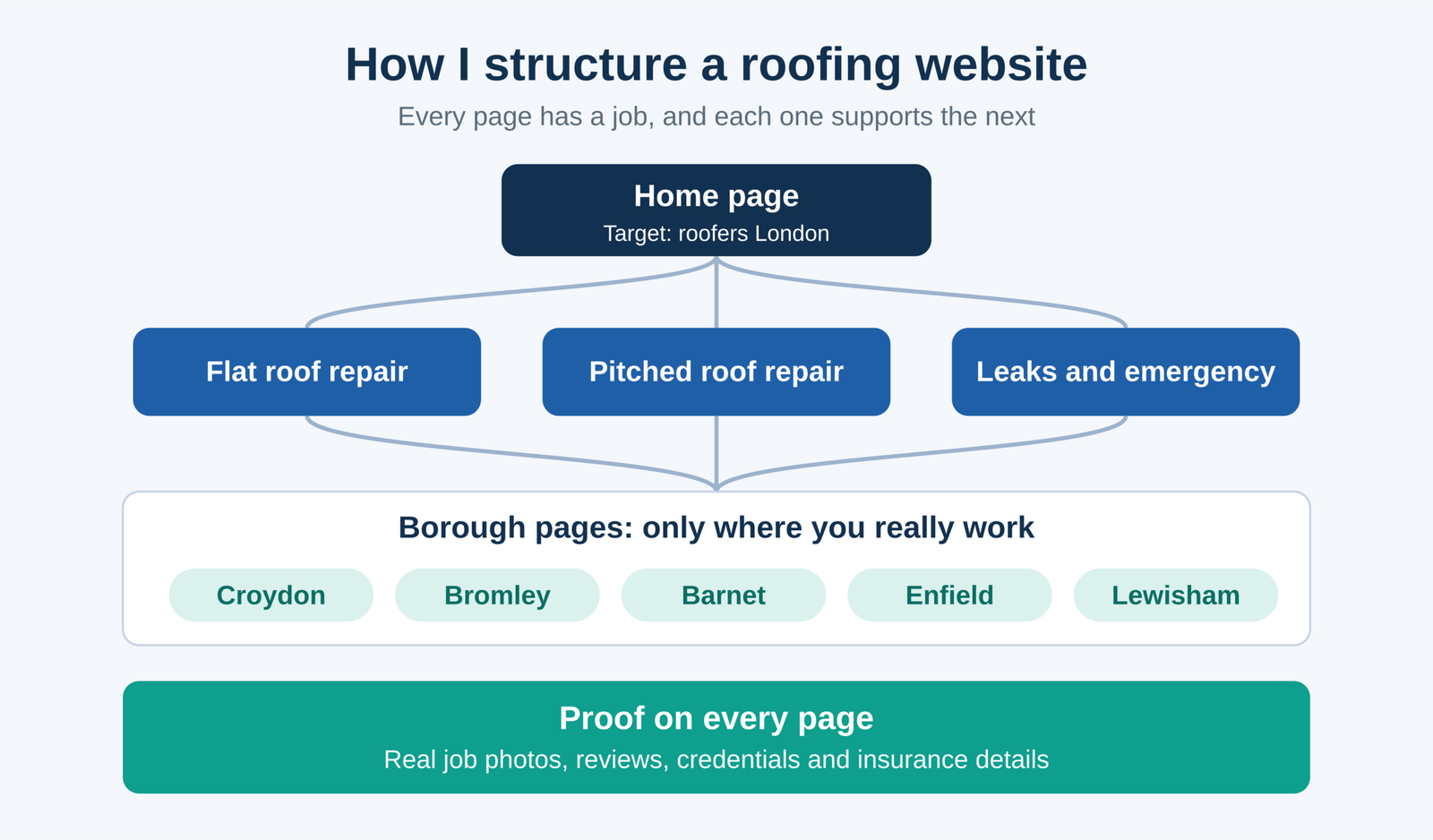
| Page type | Targets | What to include |
|---|---|---|
| Home page | “roofers London” | Services, areas covered, credentials, reviews, phone number |
| Service pages | “flat roof repair London”, “roof leak repair London” | Symptoms, causes, repair options, materials, typical process, photos |
| Borough pages | “roofers Croydon”, “roofers Barnet” | Only boroughs you really serve. Include local job photos, typical property types, a named recent job with the customer’s permission |
| Emergency page | “emergency roofer London” | Honest response times, what you can do on the day, what needs a follow-up visit |
| Case studies | Supports all of the above | The problem, what you found, what you did, cost range if you are happy to share it |
| About and contact | Trust and conversion | Real names, real address policy, credentials, insurance |
How I outline a borough page:
- Open with the roof types that are common in that borough.
- Name the services you really carry out there.
- Add photos from your own jobs in the area.
- Describe one recent job, with the customer’s permission.
- Finish with the nearby areas you cover and a clear way to call.
A roofer in Bromley can write about Victorian and Edwardian terraces with slate roofs and lead valleys, while one in Barking can write about 1930s semis and flat-roofed extensions. That is specific and accurate, and a competitor who copies your page cannot match it. I never copy one borough page and swap the name, because readers notice and search engines treat thin near-duplicates poorly.
For a roof leak page, I cover the signs to look for, the safe checks a homeowner can make from the ground, when to call a roofer, temporary measures, and repair versus replacement. I would never tell anyone to climb onto a wet roof.
I use the same area-specific approach in other trades. My guide to SEO for gyms in London shows the idea, where “Yoga Classes in North London” beats a bare “Yoga Classes”.
What do London homeowners search for?
| Search type | Examples | Intent |
|---|---|---|
| Broad local | roofers London, roofing company London | Compare options |
| Service plus place | flat roofing London, roof repair London | Ready to enquire |
| Urgent | emergency roofer London, roofer near me | Needs help today |
| Borough | roofers Croydon, roofers Enfield | Wants someone local |
Use these phrases naturally in headings and body text. Do not repeat them on every line.
How do citations and local links help?
Citations are mentions of your business name, address (if public) and phone number on other sites. Directories help establish trust and visibility, and links from local builders, community sponsorships and local news can also help.
I aim for accuracy over volume. Use the same business name, phone number and website everywhere. Prioritise sources a real customer might use: your trade body, a TrustMark entry if you hold one, local council or community sites, and suppliers who list their stockists.
How do I show up in AI search answers?
Google states that the existing SEO fundamentals continue to apply to AI Overviews and AI Mode, and that specific optimisation is not required. So I do the same work for both:
- Clear service pages that say what you do and where.
- A complete, accurate Google Business Profile.
- Structured data that matches the visible text on the page.
- Real mentions from real sources. Seeking inauthentic mentions may be treated as spam.
Google’s AI features may run several related searches in the background to build an answer. A roofer who covers the subtopics (flat roofs, leaks, guarantees, costs, areas) has more chances to be found.
What should I track, and how long does it take?
Nobody can promise a ranking date, and anyone who does is guessing. I track these and look at trends over months:
- Calls, direction requests and website clicks from the Google Business Profile.
- Organic visits and enquiries by page in Google Search Console.
- Enquiries by source, including which became booked jobs.
- Review count, average rating and reply rate.
The metric that matters most is booked jobs from search, not rank position.
Where should I start?
Do not try to fix everything at once. This is the order I would work in over the first month.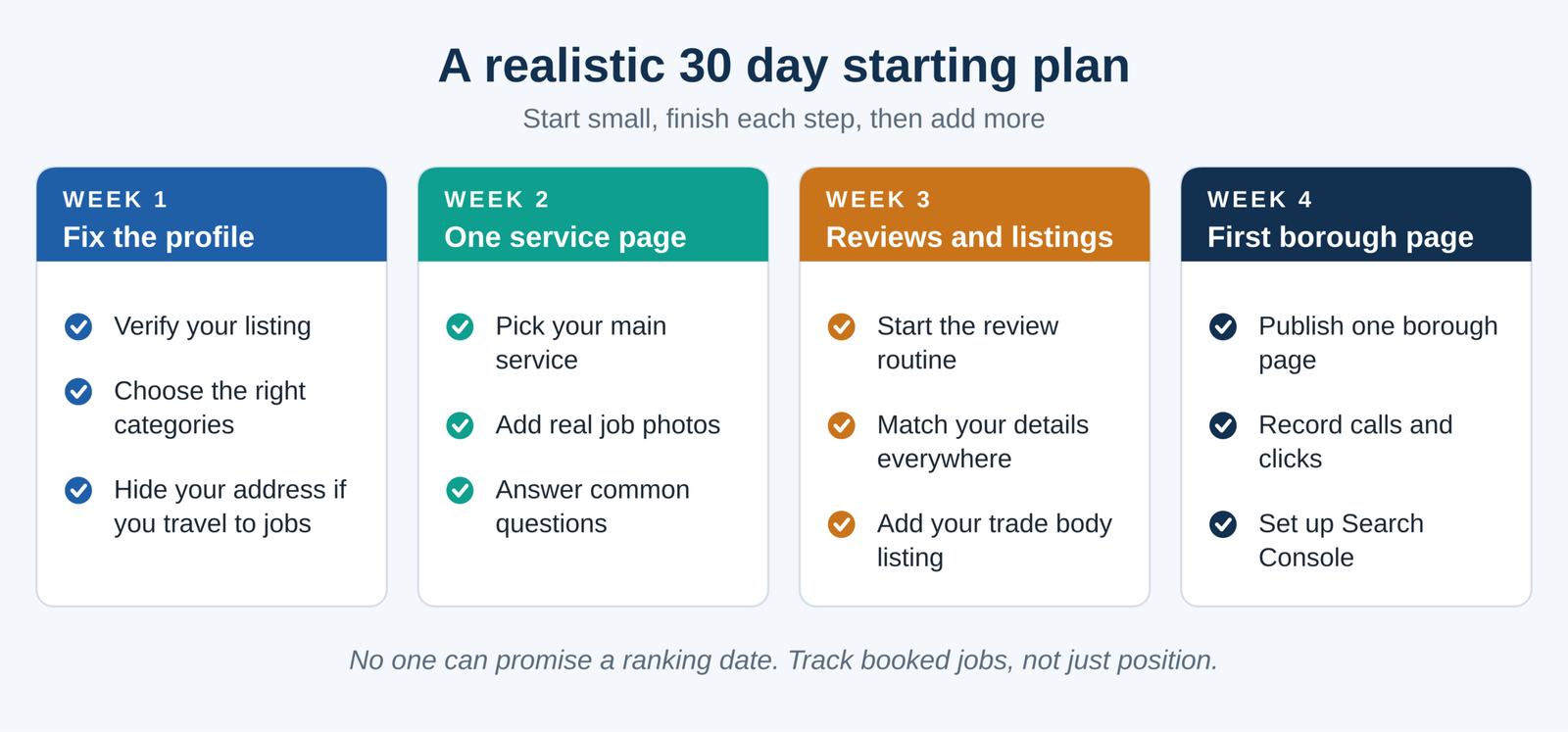
If you want a second opinion on your setup before you start, you can book a free SEO audit and consultation. More practical guides are on the blog.
About the author: Robiul Alom Ronju is a Local SEO consultant who helps local and service businesses improve their Google Business Profile, map rankings and local search visibility. His About page lists roofers among the trades he has worked with.
Part 3: FAQ and sources (add under the article)
Frequently asked questions
Do I need an office in London to rank for “roofers London”?
You need a real base from which you serve customers. A rented virtual office does not qualify unless it is staffed, so use your genuine working address and set a service area.
Can I hide my address on Google?
Yes, if customers do not visit you. Google’s guidance for service-area businesses is to hide the address and list the areas you serve.
How many reviews do I need to rank?
Google does not give a number. It says review volume and score both factor into local ranking, so aim for a steady flow of genuine reviews and reply to them.
Is Checkatrade or MyBuilder enough?
Directories can support your profile and may send enquiries. ProfileTree describes lead platforms as renting you enquiries rather than building an asset you own, so most roofers combine both.
How long does local SEO take for a roofer?
It varies with competition, your starting point and how fast you can add reviews and content. I track calls and booked jobs monthly rather than waiting for a fixed date.
Do I need schema markup?
Google says no special markup is required for AI features, but structured data can support rich results. If you add it, it must match what is visible on the page.
Sources
- Google Business Profile Help: local ranking
- Google Business Profile Help: representing your business
- Google Search Central: AI features and your website
- Practical Ecommerce: Google says AI optimization is just SEO
- Osborne Clarke: CMA and fake reviews
- CMS Law: the DMCC Act bans fake reviews
- NFRC: advice for homeowners
- NFRC: TrustMark roofing contractors
- RCI Magazine: NFRC and the Which? survey
- Whito guide (vendor source, verify on GOV.UK)
- MagnifyLab: SEO for roofing companies
- ProfileTree: SEO for roofers

